Everyone knows Disney is great for creating family memories, keeping kids occupied, and… facilitating philosophical discussion?
As a 20-year-old, I am not ashamed to say I am still a fan of Disney. Although I thought I had grown out of it, my girlfriend rekindled the magic of Disney within me quite a while ago, and now I find myself singing songs, rewatching some of my favorites, and even keeping up with the new ones that come out. One of our favorite tracks to sing along to in the car is Encanto (if you haven’t seen it, I highly recommend it), and during the song Surface Pressure, a line came up that not only sums the entire song but began a thought process that I have enjoyed exploring.
“Under the surface
Was Hercules ever like, ‘Yo, I don’t wanna fight Cerberus?’”
The line, which says, “Under the surface/Was Hercules ever like, ‘Yo I don’t wanna fight Cerberus?’” made me begin to think of two mythological characters and the recent influence they’ve had on my thought process: Sisyphus and Atlas.
Sisyphus
Sisyphus, the King of Corinth, became known for his trickery, even cheating death twice. Being fed up with this, Zeus sent him to eternal punishment in Hades pushing up a boulder up a hill, only for it to roll back down every time Sisyphus nears the top.
Hypothetically, Sisyphus could sit at the base of the hill for the rest of his eternal punishment instead of pushing the boulder, but he chooses, time after time, to push the boulder up. Even though it is such a trivial task, Sisyphus assigned his own meaning to it. Truly believing, despite the rule of the gods, that if he continues to try, he will succeed. Some scholars note this as delusion: the human belief that life has meaning; other scholars note this as perseverance: the indomitable human spirit.
Atlas
Atlas, a titan and enemy of the gods, was also punished by Zeus, after being defeated in the war between the Titans and the gods. Atlas was condemned to hold the sky above Earth, often depicted as Atlas literally having the world on his shoulders (sometimes his back).
Atlas later has a run-in with Herakles and gets a small break before returning to his punishment, where he was later turned into a stone mountain to continue holding the sky for eternity. Outside of his time with Herakles, however, Atlas embodies endurance. Atlas also has somewhat of a choice: he could allow the sky to collapse, killing himself and the entire Earth with him, but he chooses to endure, for death would be him giving in to his defeat. By enduring his punishment, he still shows his resistance to the gods.
Hercules
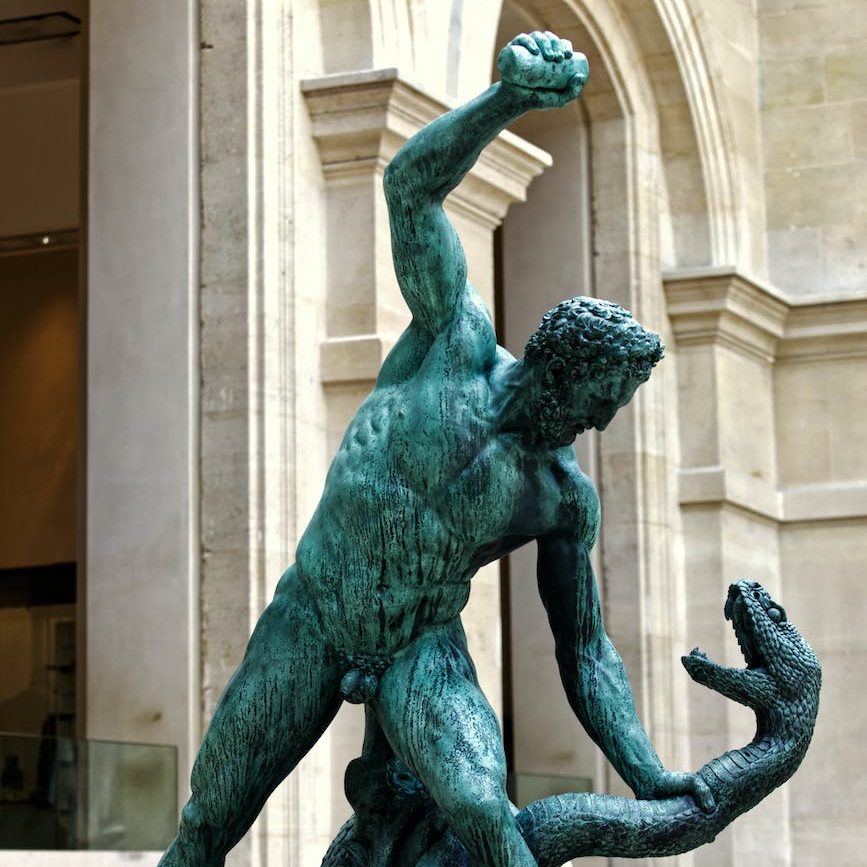
Hercules’ story is more well-known, even though he is the only Roman myth on my list (originating from Herakles in Greek mythology). Hercules, a demi-god, sought to prove his worth and was given 12 trials to overcome in order to do so. Having divine blood in him, he ultimately completed the challenges and became known as one of Earth’s greatest heroes.
In line with the theme, the trials were given to Hercules as punishment for killing his family after being told by the gods that his family was his enemies in disguise. The trials were intended to kill Hercules and give peace to Hera, who was jealous of Hercules’ success. The trial that the song references is the task to kill Cerberus, the three-headed dog and guardian of Hades, the underworld (and god of the underworld – they shared the name). After going through something so tragic, it would be understandable that Hercules would simply give up his life to be reunited with his family in the afterlife, but he chose to complete 12 of the hardest tasks possible simply to spite the gods and continue sticking up for himself and humanity.
Did he want to fight Cerberus?
So, back to the question: did Hercules want to fight Cerberus? Possibly not. Not only was it a feat that gods failed at, but Hercules himself likely wanted to simply let Cerberus kill him and reunite with his family. However, Hercules realized it didn’t matter what he wanted to do; what mattered is what he needed to do. Hercules had god-given (literally) abilities that he could use to protect the less fortunate humans that didn’t have that bestowed power. Hercules could turn his back on the rest of the world and serve himself, but he realized the amounted to more than that. He had a responsibility according to his abilities. As said by Uncle Ben, the early caretaker of Peter Parker (Spider-Man), “With great power comes great responsibility.” Hercules understood that long before Stan Lee made the beloved web-slinger we know today.
While I am no Hercules in physical terms, we all have abilities that could help those around us. However, we often get caught up in the current culture of taking care of ourselves first, letting others fend for themselves, allowing someone else to help instead of us, and overall simply being selfish. When I find that I’m asking myself, “Why am I doing this? Do I really want to?” I then ask myself, “If I don’t, who will?” Even then, when I’m able to come up with an answer, I have to ask myself, “Can I do it better? Faster? Easier?” If the answer is yes to any of these, then it doesn’t matter if I want to; I need to, much like Hercules; it is the great responsibility I must fulfill with my great “power,” no matter how small.
“[…] For unto whomsoever much is given, of him shall be much required: and to whom men have committed much, of him they will ask the more.” – Luke 12:48 [KJV]
 What's Luke Thinking?
Leave a comment